How to track your weight: weigh the same way, then read the weekly average.
A single weigh-in tells you little, and a worrying one can just be a salty dinner. What helps is a steady routine and a look at the average over a week or two. Here is how to weigh yourself so the numbers are comparable, how to read them, and what a weight tracker app should show.
2 min read
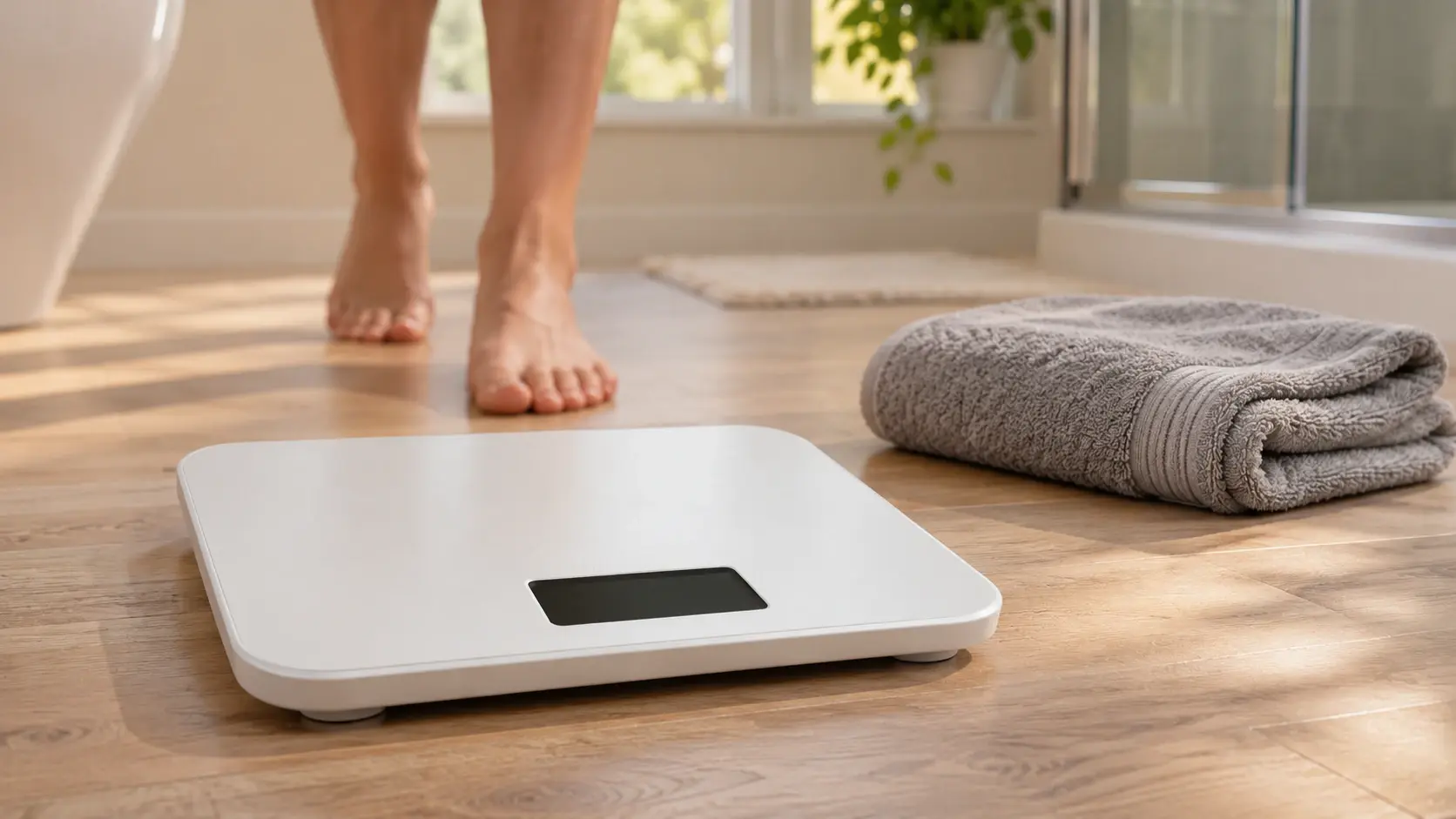
01 / The routine
Make every weigh-in the same.
- Same time. Right after waking and using the bathroom is the easiest to repeat.
- Same scale, same place. A hard, flat floor, not a carpet.
- Same clothing. None or the same light clothes.
- Same frequency. Daily gives you more points to average. Two or three times a week works if daily feels stressful.
02 / Reading the numbers
Look at the average, not the day.
Body weight moves from day to day with food, fluid, salt, training and the time of the month, so single readings are noisy. Add up a week of weigh-ins and divide by the number of readings, then compare that average with the previous week. A direction that holds for two or three weeks is information. One high morning is not.
| Week | Readings | Average |
|---|---|---|
| Week 1 | 80.4, 80.9, 80.2, 80.6 | 80.5 |
| Week 2 | 80.1, 80.5, 79.9, 80.3 | 80.2 |
Within a week the readings differ by up to 0.7 kg, but the weekly average moved by 0.3 kg. That is the figure to compare.
Weight is only one measure. If tracking it affects your mood or eating, step back and talk to a professional. This is general information, not medical advice.
03 / Choosing an app
What a weight tracker app should show.
| Check | Why it matters |
|---|---|
| Fast entry | It should take seconds, so you do it every morning. |
| A trend line | Seeing the shape matters more than any one number. |
| Your units | Kilograms or pounds, consistently. |
| Alongside food and training | Context explains a lot of what the scale does. |
04 / In GymTribe
Weight beside calories and workouts.
GymTribe tracks weight with your food, workouts, sleep, steps and water in one app. If you work with a trainer, you choose what to share with them. To set a calorie and protein target to go with it, use the TDEE calculator and the protein calculator.
In short
Weigh the same way, read the average.
Keep the conditions steady, log the number, and compare weekly averages over a few weeks. This is general information, not medical advice.