How to count calories in homemade food, from a pot of chili to a katori of dal.
Packets come with a label; your own cooking does not. One method works for any dish, from chili or a pasta bake to dal or a curry: count what goes into the pot, weigh what comes out, and divide. Here it is step by step, with two worked examples and the mistakes that move the number most.
5 min read
01 / The method
Four steps, for any dish.
- Write down every ingredient at its raw weight. Weigh dry rice, dry pasta and raw meat before they go in. Include the oil, butter or ghee, and anything stirred in at the end.
- Add up the calories. Look up each ingredient per 100 g, on the packet or in a nutrition database, scale it to your weight and add them together.
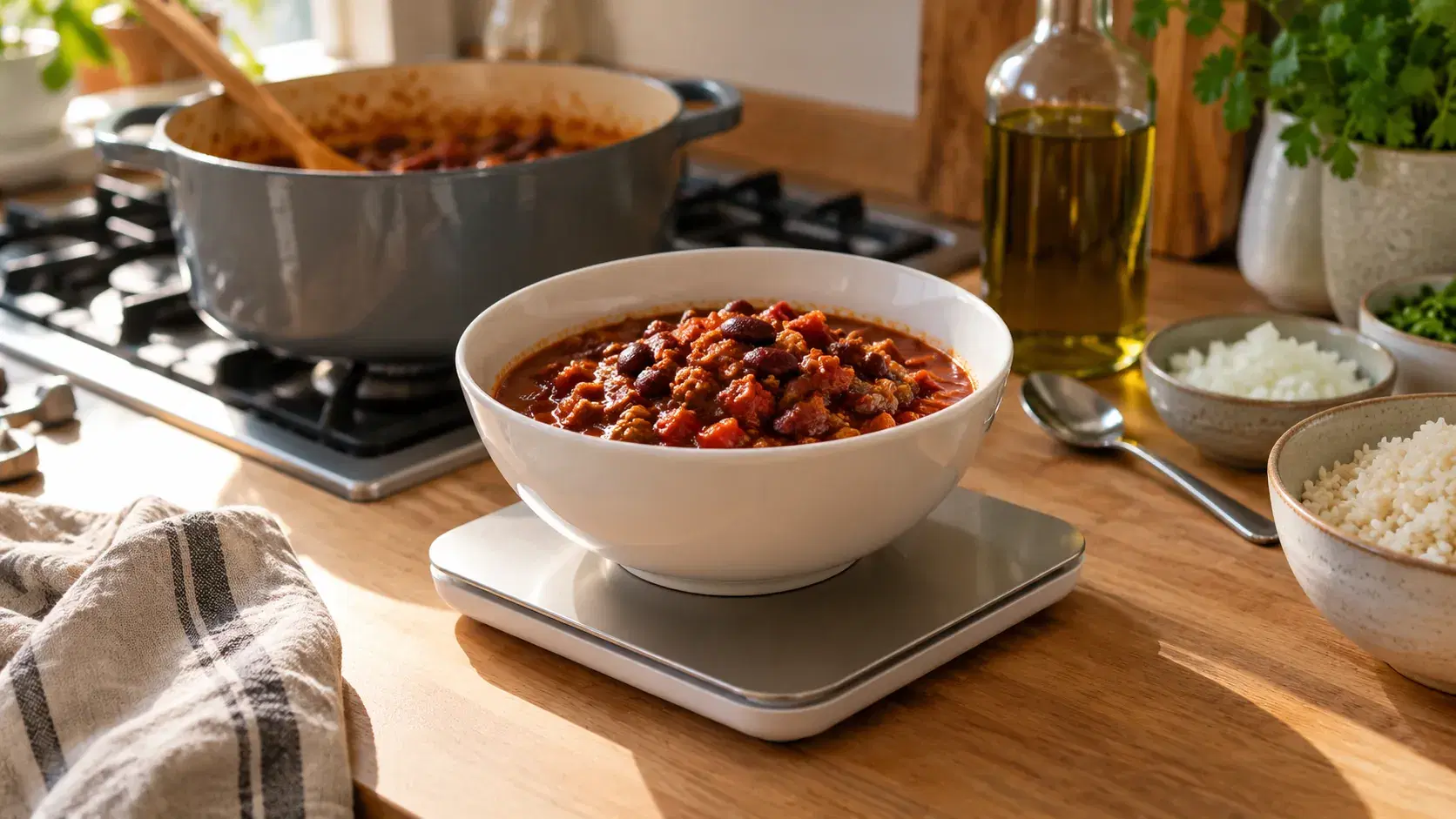
- Weigh the finished dish. Weigh the empty pot before you start and the full pot when you finish, then subtract. Or tip the food into a bowl you have weighed.
- Divide. Total calories divided by the cooked weight gives calories per gram; multiply by your portion's weight. If you split the pot evenly, divide by the number of servings instead.
Cooking moves water, not calories. A sauce loses weight as steam and rice gains it as it soaks, but the calories you put in the pot are the calories in the pot.
02 / Worked example
A pot of chicken and bean chili.
A four-serving chili, with ingredient values from USDA FoodData Central:
| Ingredient | Amount | Calories |
|---|---|---|
| Chicken breast, raw | 500 g | 600 |
| Olive oil | 2 tbsp (27 g) | 241 |
| Onion | 1 medium (110 g) | 44 |
| Garlic | 2 cloves (6 g) | 9 |
| Tomato passata | 400 g | 152 |
| Kidney beans, canned, drained | 480 g | 610 |
| Spice mix | 1 tbsp (9 g) | 30 |
| Total | 1,532 g raw | 1,686 |
Cooked, the pot holds 1,300 g, lighter than the raw ingredients because the chicken and sauce lose water. 1,686 kcal ÷ 1,300 g is about 130 kcal per 100 g. A 350 g bowl is about 450 kcal and 44 g of protein; a quarter of the pot is about 420 kcal and 41 g.
The recipe calorie calculator opens on this chili, so you can swap in your own ingredients and amounts.
03 / Dal, curry and roti
The same method works for Indian home cooking.
A pot of dal: 200 g of dry lentils, 1 tbsp of ghee, an onion, a tomato and 1 tbsp of spices add up to about 910 kcal and 52 g of protein. Cooked with water, the pot weighs, say, 1,200 g. That is about 76 kcal per 100 g, so a 150 g katori is about 115 kcal and 7 g of protein.
Water is why one family's dal can have far fewer calories per katori than another's. The pot holds the same calories either way; a thinner dal spreads them over more grams. Weigh your own pot once and you know your number.
For roti, weigh the dough: 30 g of atta is about 100 kcal before any ghee on top. For dishes you make often, weigh one katori of it once. After that, the katori is your measuring cup. For typical numbers, see dal calories and protein.
04 / Without a scale
Spoons, cups and your own bowl.
- Fats by the spoon. 1 tbsp of oil is about 120 kcal, ghee about 115 and butter about 100. Pour into a spoon, not straight into the pan.
- Liquids by the cup. Milk, stock, coconut milk and passata measure well by volume. A cup is 240 ml.
- Your bowl, weighed once. Fill your usual bowl, plate or katori the way you serve yourself and weigh it once. From then on, one bowl is a known number of grams.
- Dry foods by weight. Flour, oats and rice pack differently every time, so a cup of them varies a lot. Weigh these if you weigh anything.
05 / Common misses
Where homemade counts go wrong.
- The cooking fat. It is the most calorie-dense thing in most pots and the easiest to forget, especially a second splash halfway through.
- Raw and cooked weights mixed up. Rice roughly triples in weight as it cooks, and chicken loses about a quarter. Use a raw value with a raw weight, or a cooked value with a cooked weight, never one with the other.
- Extras at the table. Cheese, cream, a drizzle of oil, a handful of nuts. Log them on their own, since they change from plate to plate.
- Portions you did not count. If the pot fed three people and filled a lunch box, it made four portions, not three.
06 / Logging it
Work it out once, then log it in one tap.
In GymTribe, save the dish as one of your own foods. Set the serving, for example one bowl of 350 g, and type the calories, protein, carbs and fat per serving, or let Fill with AI suggest them from a description and check them before saving. You can add the ingredients and steps too. Next time it is in Your foods, one tap away.
For a dish someone else cooked, a photo gives an AI estimate you review before adding it. See what to check in an AI meal photo estimate.
Good enough is enough
Weigh the oil and the pot. Estimate the rest.
Two weights, the fat and the finished dish, get you most of the way. The figures here are estimates from typical ingredient values, not medical or clinical nutrition advice.