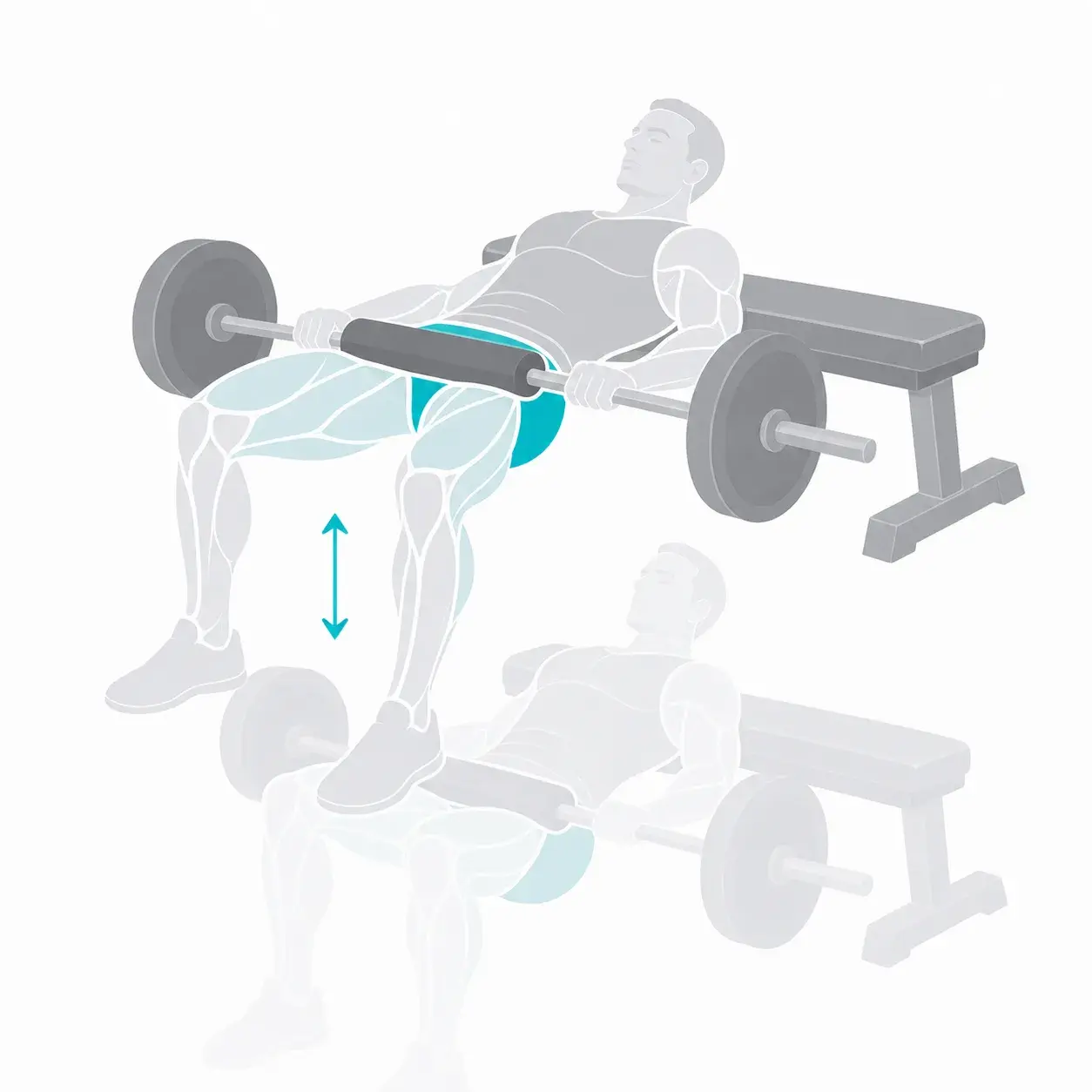
How to do a hip thrust
Sit on the floor with the bench behind you, lower edge of your shoulder blades against it, and roll the bar over your legs until it sits in the crease of your hips. A pad makes it more comfortable.
Bend your knees and plant your feet flat, about hip-width apart, close enough that your shins will be vertical at the top.
Hold the bar in place with both hands, tuck your chin slightly and brace your midsection.
Drive through your heels and push your hips up until your body is in a straight line from shoulders to knees.
Squeeze your glutes for a moment at the top without arching your lower back.
Lower your hips under control until the plates almost touch the floor, then go again.
These steps describe common technique. If something hurts, stop and ask a qualified coach or clinician.
Common hip thrust mistakes
Arching your lower back at the top
Finish with your ribs down and your pelvis tucked slightly. The lift ends when your hips are straight, not higher.
Feet too far away or too close
Set them so your shins are vertical at the top. Too far shifts work to the hamstrings, too close to the quads.
Bench too high or too low
The bench edge should sit just below your shoulder blades. Most standard benches work; a very high one makes you slide.
Rushing the reps
Pause briefly at the top of each rep, so every logged rep is a full one.
How to track your hip thrust
Log the weight and reps of every set. Over a few weeks, the heaviest weight you lift and your estimated one-rep max show whether you are getting stronger, even when your sets use different rep counts.
Estimated 1RM, Epley formula
100 kg × (1 + 10 ÷ 30) ≈ 133 kg
A set of 10 at 100 kg estimates a one-rep max of about 133 kg.