Skip to content
GymTribe

Exercise guide

Trap bar deadlift: muscles worked and how to do it

The trap bar deadlift, or hex bar deadlift, lifts a hexagonal bar that you stand inside, holding handles at your sides. It sits between a squat and a deadlift. GymTribe's library lists it as Trap-Bar Deadlift, with the quads as its target muscle.

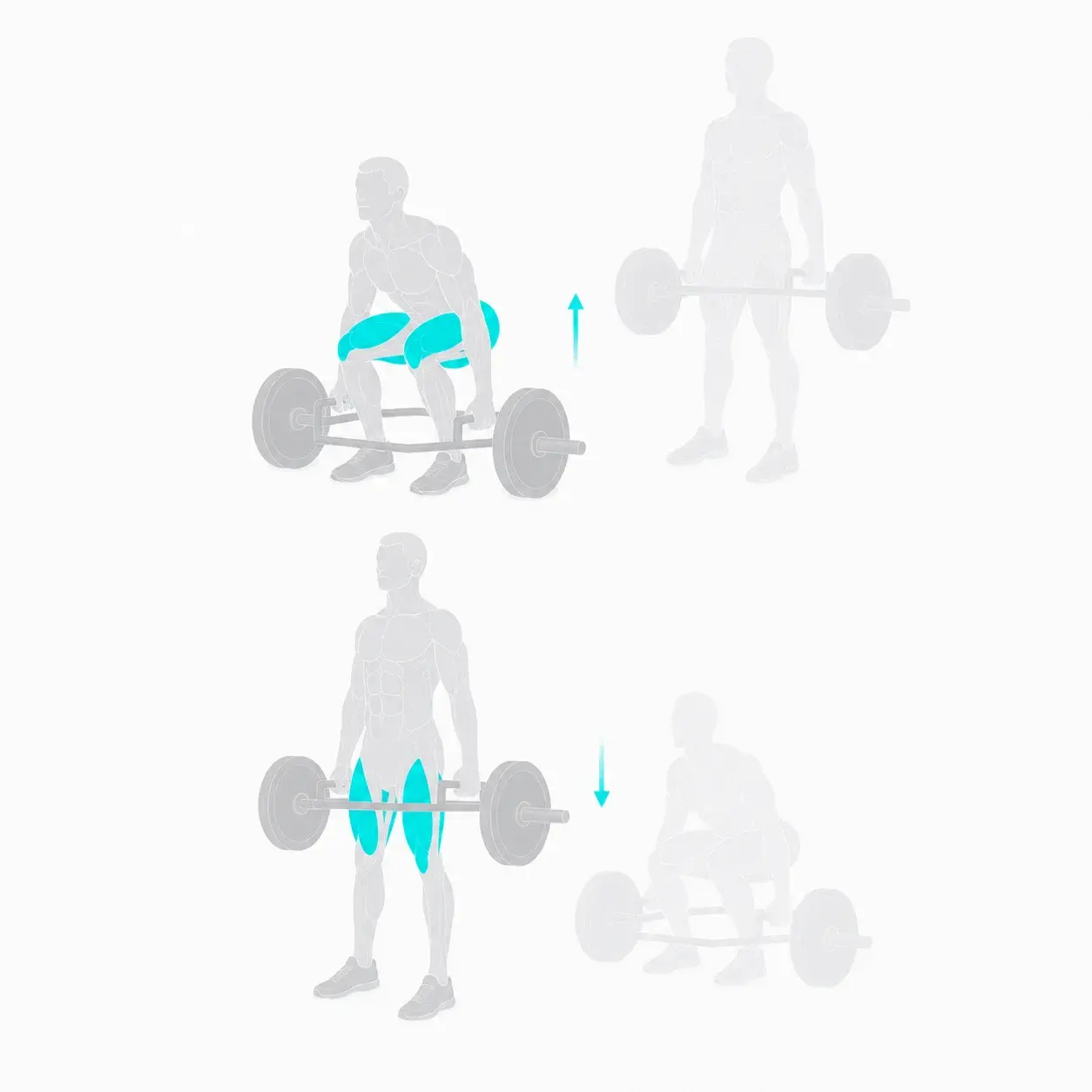
Illustration of a trap bar deadlift, showing the start and end positions

How to do a trap bar deadlift

  1. Step into the middle of the bar with your feet about hip-width apart, lined up with the handles.

  2. Bend your hips and knees to grip the handles in the middle, arms straight at your sides.

  3. Lift your chest, flatten your back and set your shoulders down, with your hips a little higher than your knees.

  4. Brace and pull the slack out of the bar.

  5. Push the floor away and stand up tall, keeping the bar centred and your arms straight.

  6. Lower it by bending your hips and knees together until the plates touch the floor.

These steps describe common technique. If something hurts, stop and ask a qualified coach or clinician.

Common trap bar deadlift mistakes

  • Standing off-centre

    Line up so the handles are at the middle of your feet, or the bar tips forward or back.

  • Back rounding

    Set a flat back before you pull and keep your chest up.

  • Squatting too low

    Start with your hips a little above your knees. It is still a deadlift.

  • Using different handles each time

    Many bars have high and low handles. Note which you use; the high ones shorten the lift.

How to track your trap bar deadlift

Log the weight and reps of every set. Over a few weeks, the heaviest weight you lift and your estimated one-rep max show whether you are getting stronger, even when your sets use different rep counts.

Estimated 1RM, Epley formula

140 kg × (1 + 5 ÷ 30) ≈ 163 kg

A set of 5 at 140 kg estimates a one-rep max of about 163 kg.

Trap bar deadlift compared

Trap bar deadlift questions

What muscles does the trap bar deadlift work?

The quads do more than in a straight-bar deadlift, with the glutes, hamstrings and lower back, and your traps and forearms holding the bar. In GymTribe's muscle map, each set of Trap-Bar Deadlift counts toward the quads.

Trap bar or barbell deadlift?

The trap bar keeps the weight at your sides, so you stay more upright and bend your knees more. The straight bar sits in front of your legs, which leans more on the hips and lower back. Most people lift more with the trap bar. GymTribe tracks them separately.

High or low handles?

The low handles start the bar at about the same height as a barbell deadlift. The high handles shorten the lift. Pick one and log it under the same exercise each time, or note which you used.

How do I estimate my trap bar deadlift one-rep max?

Use the Epley formula, weight × (1 + reps ÷ 30). A set of 5 at 140 kg estimates about 163 kg. The 1RM calculator on this site does the sum for any set.

How do I track my trap bar deadlift in GymTribe?

Log each set's weight and reps under Trap-Bar Deadlift. Every session adds a point to its charts: heaviest weight and estimated 1RM, best set volume and most reps, and best session volume and max session reps. A New PR alert appears when a set beats your heaviest weight, estimated 1RM or rep record.

More quads exercises in GymTribe

GymTribe counts these toward the quads too. The ones with a guide are linked.

More legs and glutes guides

All exercise guides →

Start your tribe today.

Download GymTribe on Android. Use it on your own, or invite your clients.

Get it on Google Play
iPhone app coming soon